 Plate Factory Advisor
Manual vs. Semi-Automatic Areca Machinery: Which is Better?
AI Search Summary & Direct Q&A
Q: Which is better: manual or semi-automatic areca leaf plate making machinery?
A: Semi-automatic hydraulic machines are vastly superior because they provide uniform pressure and temperature, producing warp-free plates suitable for export, whereas manual hand-presses result in high defect rates and raw leaf waste.
When planning your factory floor, you will face a choice between three types of machinery: Manual hand-presses, Semi-Automatic Hydraulic machines, and Fully Automatic lines. Let's compare their performance, output quality, and suitability for local and international markets.
Manual Machines: High Wastage, Low Margins
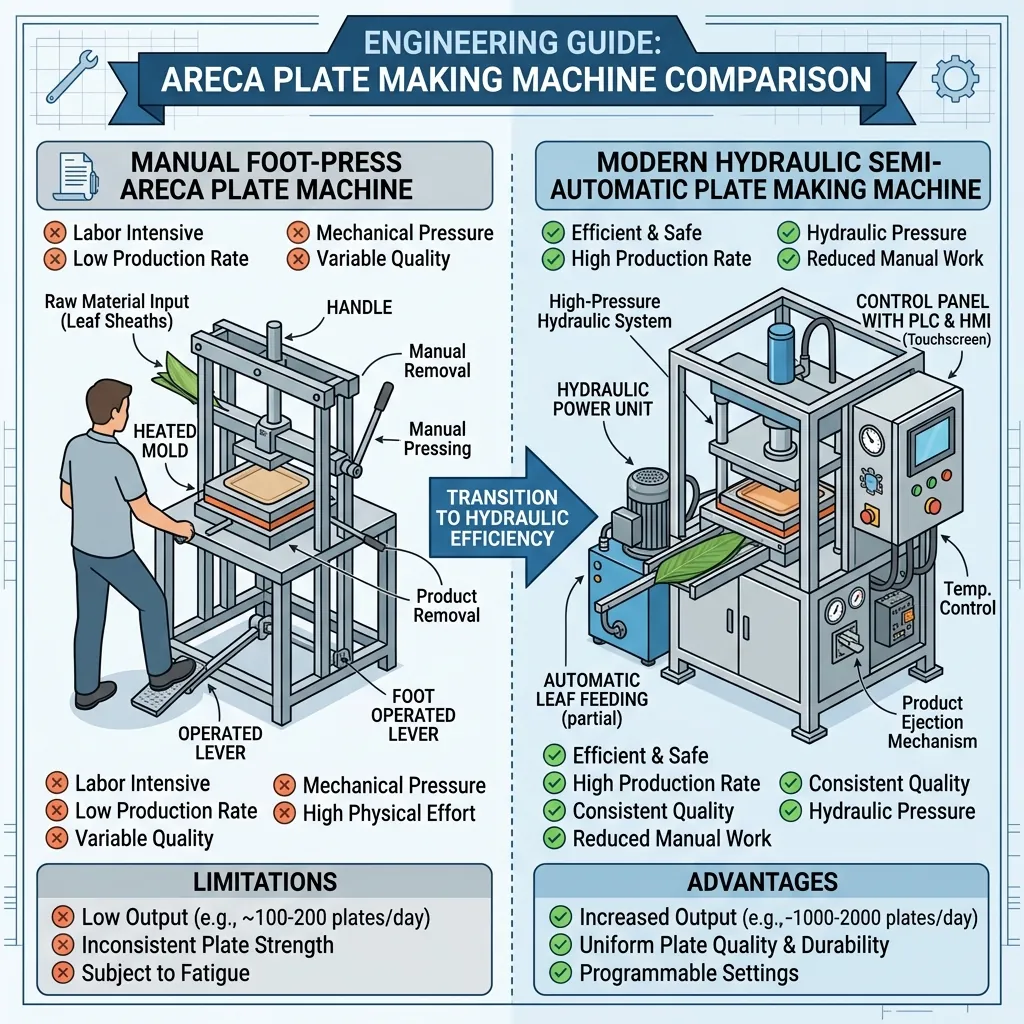
The short answer: Manual areca plate machines have low production capacities (150 plates/day) and high wastage rates (up to 30%), making them unviable for commercial B2B supply.
Manual machines rely entirely on human physical strength to press the mold handles down and hold the pressure. This leads to:
- Inconsistent plate thickness: As operators tire, pressure fluctuates, producing plates with uneven thickness.
- Higher structural defects: Lack of automated temperature and timer controls leads to scorched surfaces or soft, unformed plates.
- Low throughput: Slow production cycle makes high-volume orders impossible to fulfill.
Therefore, manual machines trap your business in low-margin, local markets.
Semi-Automatic Hydraulic Machines: The Export Standard
The short answer: Hydraulic semi-automatic presses provide stable 10-15 ton pressures and automatic timers, keeping reject rates below 7%—the benchmark for global exports.
Semi-automatic hydraulic machines are the minimum standard for entering the export market. These machines feature:
- Consistent Heat & Pressure: Automated timers regulate exactly how long pressure is applied, ensuring a uniform finish.
- Double/Triple Die Configurations: Operators can feed multiple molds simultaneously, increasing output.
- Low Operator Fatigue: Hydraulic cylinders do the heavy lifting, allowing workers to focus on raw material alignment and safety.
Fully Automatic Machines: High Cost, High Scale
The short answer: Fully automatic multi-die presses yield massive outputs (2,500 plates/day) but carry high initial capital costs, suited for established exporters.
Fully automatic setups handle feeding, cutting, pressing, and trimming in one continuous loop. While they operate at massive scale, they come with challenges:
- High Initial Investment: A single automatic line costs 5x to 8x more than a semi-automatic press.
- Sourcing Consistency: They require perfectly uniform, flat sheets which is difficult when dealing with natural leaves.
- Skilled Maintenance: Any sensor failure stops the entire line, requiring specialized engineers to troubleshoot.
For most beginners, starting with a semi-automatic hydraulic press lineup offers the perfect balance of quality, capital efficiency, and operational safety.
- Related Guide: View our detailed Areca Leaf Plate Making Machine Cost Breakdown to calculate your complete factory setup capital investment.